
By Thomas K. Pendergast
Despite losing at the ballot box and in court, those opposed to banning private motor vehicles on the Upper Great Highway between Lincoln Way and Sloat Boulevard plan to start gathering signatures for another ballot measure in November.
The issue goes back to 2020, when the popular roadway was shut down as a response to the COVID-19 pandemic, giving people sheltering in place recreation space with adequate social distancing.
In 2021 a citizen group called Open The Great Highway Alliance sued to open both the highway and John F. Kennedy Drive (also closed to motor vehicles) in Golden Gate Park, however, a judge denied the motion for a preliminary injunction early in 2022.
Later that year a compromise was worked out by then District 4 Supervisor Gordon Mar, which would open the highway up to motor vehicles on weekdays, while shutting the roadway down on Friday afternoons for the weekends and opening it up again on Mondays.
In November of 2022, Proposition I went on the ballot, which would have opened both JFK Drive and the Upper Great Highway to motor vehicles and forbidding the City from closing the Great Highway extension between Sloat and Skyline boulevards. It went down in defeat, however, with 34.89% voting in favor and 65.11% voting against.
After a hard-fought campaign pitting westside motorists against park enthusiasts, Proposition K passed in November of 2024, which banned motor vehicles altogether from the Upper Great Highway between Lincoln Way and Sloat Boulevard.
The voting statistics revealed a deep divide between the west side and the rest of the City. In the Sunset, Prop. K lost to a 60% “no” vote and even more so in the Richmond, where it was rejected by 70%. The measure passed citywide, however, with 54.7% voting in favor.
This past January, a legal challenge against Prop. K lost when San Francisco Judge Jeffrey Ross denied arguments brought by the plaintiffs, essentially finding that Prop. K complied with California law.
Immediately after the hearing, Lucas Lux – who led the effort to close the highway to private motor vehicles and create a new city park, since dubbed Sunset Dunes – expressed his frustration at continuing efforts to bring back the compromise that had been in place before Prop. K was passed.
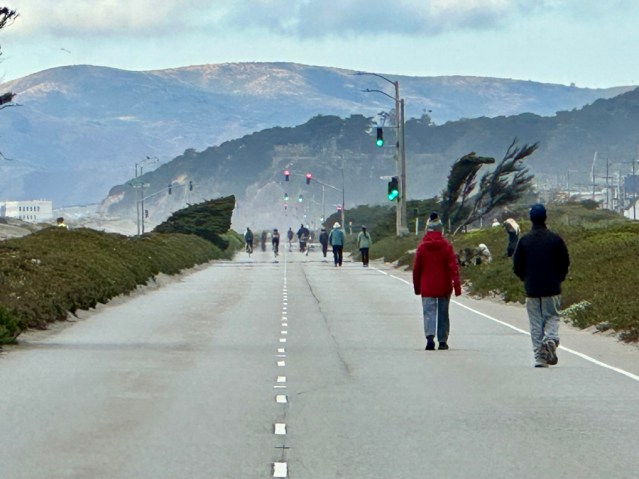
“While our volunteers are giving their time to bring a coastal park to life, the anti-park zealots continue to waste more public resources in their attempt to overturn the will of the people and close a coastal park,” Lux said. “And now that they’ve lost two lawsuits and two elections, we invite them to accept the will of San Franciscans and work with us to make the most of our coast together.”
Matthew Boschetto, one of the plaintiffs who brought the lawsuit, said that they will appeal that decision.
“We feel very confident in our arguments,” Boschetto said after the hearing. “We feel that the judge is misreading them at the most gratuitous. And we think this is ripe for appeals and we will seek it.”
Seemingly there are others on the west side who will not be accepting Lux’s invitation any time soon. Previously they organized a petition drive for a recall election against former District 4 Supervisor Joel Engardio, who championed Prop. K, eventually resulting in his removal from office.
Now they are hoping to harness that same grassroots effort to put another measure on the ballot to overturn Prop. K.
Former SFPD Commander Richard Corriea said they are filing language with the Department of Elections to set aside Prop. K and return to Mar’s compromise.
“We don’t want to add anything new in; it’s going back to what the compromise was,” Corriea said.
Jamie Hughes is a campaign consultant who was involved in the effort to recall Engardio. Since the new D-4 Supervisor Alan Wong was not able to get four supervisors to sign onto a new ballot measure, he said, they will go the same way as they did for the recall election. Hughes said they will need to get about 10,500 signatures citywide.
“What we’ve learned over the last year is that a lot of people want another chance to vote on this and a lot of sentiments have changed,” said Hughes. “The way it was done last time, it was kind of put on at the last minute, with little time to have an organized effort to highlight the successful compromise that was already in place.
“We aren’t against having it closed on the weekends, when people are actually using it. I think it’s pretty popular, but on weekdays, nobody’s using it. It’s affecting the communities who relied on it a lot.”
Hughes said the messaging in favor of Prop. K was misleading.
“It was sold as this kind of rich, pro-car people want this open and we need the shared space,” he explained. “It’s not some rich pro-car thing. This really affects working-class people trying to get to work on time, trying to get their kids to school.”
Corriea said, “People on the west side were experiencing the brunt of the impacts but the organized opposition to Prop. K never went east of West Portal.So, a large part of the City heard that there’s a park. What we look forward to doing is presenting the real impacts and the real story to an electorate who have now spent the last year trying to go north and south across the west side of town and realizing the impacts of the closure of the highway.
“They billed it as a park east of Twin Peaks,” he said. “Those sort of things are misleading. They gave short shrift to the lived experience of people during the closure: the traffic impacts, moving traffic onto high-injury corridors from a very safe Great Highway.”
There are options, of course, like 19th Avenue, but traffic along this highway is going to be choked during the next year because of a major repaving project.
Then there’s Sunset Boulevard, which will likely get most of the traffic overflow. This in turn may cause drivers to use the smaller side streets instead.
“Like it or not, the Sunset is a residential neighborhood,” Hughes said. “People don’t want angry drivers speeding down their residential streets. It’s not safe for them. It’s not safe for their kids playing.”
Should these activists gain enough signatures, the compromise will be on San Francisco voters’ November ballots.
Editor’s Note: On Friday, Feb. 20, proponents for restoring a previous compromise to share the Upper Great Highway submitted at the SF Department of Elections their intent to gather signatures to put the issue before San Francisco voters in the November election.
Categories: Upper Great Highway


 Richmond Review/Sunset Beacon
I grew up in San Francisco. The great highway was Playland at the Beach and a road to the Golden Gate Bridge. Playland was like Santa Cruz Boardwalk. Last year I was trying to get to a Car Show that was in the park since there was so many blocked and one way streets closed for people to ride bikes, walkers. Getting to this show would taken only minutes. I love this highway. It should be for everyone not just for pedestrians who can walk or bikers but, for some of us who can’t walk. Do you think we have a enough bike lanes, walkways everywhere?
LikeLiked by 1 person
I’ve lived in the Outer Sunset in the high 40s Avenues for years, and the new park has been an absolute transformation for our neighborhood. I see so many friends and neighbors out there, and it has been such a joy to see it grow and take form with new amenities. Honestly, I couldn’t believe how many people were out there during those beautiful weekdays in January. We are so lucky to have year-round great weather here, and seeing thousands of people, not just on weekends, but on regular Tuesdays and Wednesdays, enjoying our oceanfront is incredibly rewarding.
The claim in this article that “nobody is using it on weekdays” is just blatantly dishonest. Anyone can go out there and see that is untrue. It is misleading to frame this as an empty road when it is clearly a thriving resource. This is San Francisco’s one and only ocean beach and third most popular park. The fact that so many people from all over are enjoying it proves its value and this dishonest claim will fall flat for anyone who visits.
As for the traffic scares, they simply haven’t matched reality. I haven’t noticed any increase in cars speeding down my street. Sunset Boulevard is a massive, three-lane thoroughfare that handles the north/south load perfectly fine. Instead of wasting energy trying to drag us backward, we should be focusing on making the new system work better, specifically by adding lights on Chain of Lakes to make the crossing safer for pedestrians and drivers. We have something special here, let’s improve it, not destroy it.
LikeLike
Please please, can we put this debate to bed and wait for the results of a ballot measure that might or might not get on the November ballot. Right now, all we hear is “hooray for our side and the heck with the other point of view”. Some say the park is not used on weekdays. This is patently false and should not even be considered a logical argument. Others say Sunset Blvd. is like a parking lot and quagmire of cars. Again, this is a false statement with no factual information backing it up. Sharing the UGH roadway with people and cars is not feasible safety wise at all. Nor is making one lane each way for cars any kind of a solution. A one lane southbound at 5 p.m. on a weekday would be backed up all the way to the Cliff House. Although I didn’t vote for the closure, I can live with the democratic decision made by the majority of San Franciscans. The way it was, closed on weekends and open on weekdays was OK except for the ridiculous excuse of the Park & Rec dept. that they had to close it at 12 P.M. on Fridays because they had no one to close it at say 9 p.m. This led to a big snafu on Friday afternoons when the majority of cars had to find another route to the south to get home. Pure stupidity from the Park & Rec dept. if you ask me. But the bottom line is we have to deal with the present situation, quite thinking things will change if we shout loud enough and see what happens, if anything, in November.
LikeLike
The traffic backups are fully evident. This beautiful Highway Needs To Be Open!
LikeLike
✄ Gordon Mar’s weekday/weekend “compromise” had an expiration date, tied to the 2025 closure of the Great Highway Extension. The whole point of Prop K was the next step, dealing with this reality. So this isn’t a move to “restore Mar’s compromise.”
I’ll note that Supervisors Wong and Chan’s attempted ballot measure reduced the carfree weekends to not include Friday, and also had a provision to run cars through the park on weekends as well, on ill-defined pretexts. This is, of course, less of a compromise than “Mar’s compromise.”
The word “compromise” sure gets kicked around a lot.
LikeLike
“Dealing with reality” = 300-1000 yuppies daily on bicycles inconvenience 25,000 sunset residents for the purpose of politics that don’t affect the environment in the slightest, except to endanger sunset residents with additional traffic.
And they gave a public property to a private equity group called “friends of the sunset” LLC. This is not a win for the sunset, this is a win for google lawyers.
LikeLiked by 1 person
So True.
Note- we have never seen that many Bike-a-yups on a single day.
LikeLike
Good to hear there is an effort underway to open the highway. Perhaps we need a ballot initiative to return Rec and Park to the business of protecting trees instead of removing them .
LikeLiked by 1 person