
By Noma Faingold
France’s Claude Monet (1840-1926), the founder of Impressionism and the movement’s most prolific painter, reluctantly visited Venice, Italy, in October of 1908. At the time, he had grown disenchanted with the way his “Water Lilies” paintings were progressing. His dealer, Paul Durand-Ruel, rejected the work, leading Monet to cancel the show at the Paris gallery and to destroy many of the paintings in the series.
Monet’s second wife, Alice Hoschedé, insisted that he take a break from his obsession by accepting an invitation from baroness and arts patron Mary Hunter, to vacation in Venice and stay at the Palazzo Barbaro.
Two weeks turned into two months. He was enchanted with the historic Italian city and painted up a storm. The sojourn to the romantic, mysterious city, with its waterways and architecture, not only inspired Monet’s creativity, but it also led to him evolve as an artist.
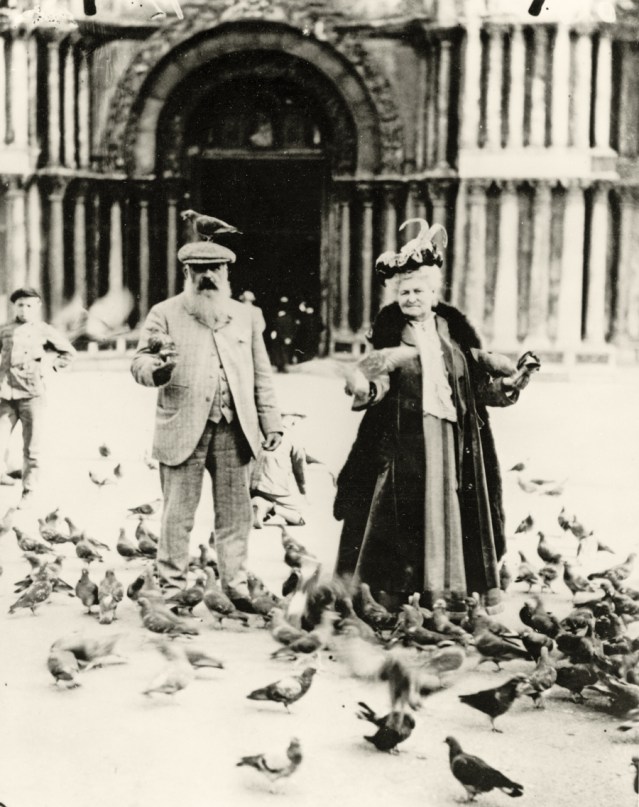
The Fine Arts Museums of San Francisco (FAMSF) and the Brooklyn Museum teamed up to mount the exhibition, “Monet and Venice,” to focus on this pivotal period in Monet’s career. The show at the de Young Museum runs from March 21 to July 26, following its presentation at the Brooklyn Museum from Oct. 11, 2025, to Feb. 1.
Monet meticulously developed his Giverny property into his home, studio and gardens with bodies of water, from 1883 until his death. Endlessly painting his outdoor environment, plein air style, his only Venice visit at age 68 resulted in 37 atmospheric paintings, 21 of which will be at the de Young.
While “Monet and Venice” arranges these rarely seen paintings chronologically, the exhibition offers a sampling of his masterpieces created before and after his Venice work.
“Our presentation should give people a sense of the door that Venice opened for Monet in his final years,” said Emily Beeny, FAMSF’s curator in charge of the European painting collection. “The paintings tell a personal story of him late in life. It’s a very human story about great works of art. Personal stories offer a way in for visitors.”
The exhibition also provides a sort of compare and contrast with other artists, who had different interpretations of Venice, such as Canaletto (Giovanni Antonio Canal), John Singer Sargent and J. M. W. Turner. These works will give viewers crucial insights into the allure and historic tradition of painting Venice.
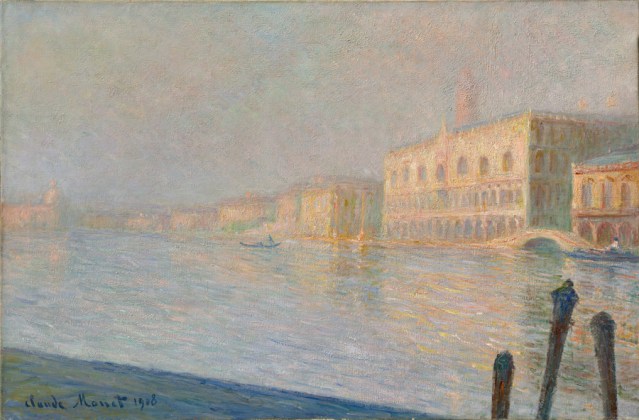
Canaletto’s lively, exacting Venice paintings almost look like photos. While Canaletto was interested in the spectacle and the crowds at Le Palais Ducal, Monet’s rendition of that same landscape is moody, devoid of people and closer to abstraction. They are focused on the water, sky and architecture. Shades of pinks, blues and greens were like new discoveries, as he painted from gondolas on the water.
“Other painters paint a bridge, a house, a boat,” Monet once said. “I want to paint the air in which the bridge, the house and the boat are to be found – the beauty of the air around them that is nothing less than the impossible.”
“Monet and Venice,” organized by Lisa Small, senior curator of European Art at the Brooklyn Museum and Melissa E. Buron, director of Collections and chief curator at the Victoria and Albert Museum, London, highlights his fixation with light and water reflections.
“It’s amazing the number of colors Monet could find in water,” Beeny said. “His landscapes looked inward instead of outward.”
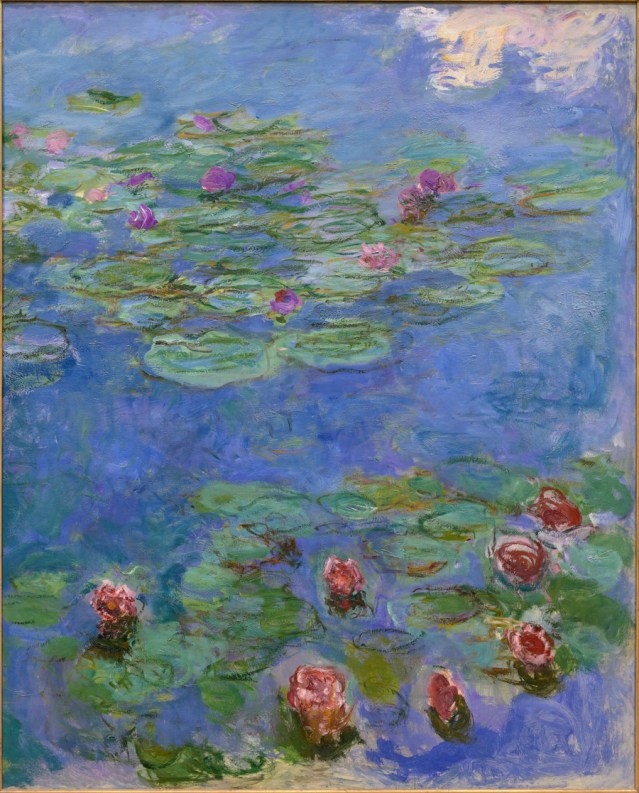
Beeny is hoping visitors “allow themselves to be immersed. There will be an ‘aha’ moment when people realize when the Venice pictures open a door to the water lilies,” she said.
Monet completed the Venice paintings at Giverny shortly after his wife died in 1911. Perhaps the period of mourning influenced the hazy, melancholy color palate of the series.
FAMSF has embraced Monet with two recent exhibitions, covering early works in 2017 and later works in 2019, as well as acquisitions to its permanent collection, including “The Grand Canal, Venice.”
Monet’s legacy has only expanded in the last 50 years, with a restored Giverny becoming a major tourist attraction in 1980, numerous major museum exhibitions all over the world and the recognition of his influence on Modernism.
San Francisco loves Monet, according to Beeny.
“He’s a great painter of water and we are a great city of water,” she said.
The “Monet and Venice” exhibition runs from March 21 to July 26 at the de Young Museum, 50 Hagiware Tea Garden Dr. Admission prices range from $25-$40. Audio tours are free with entry (sponsored by Blumberg). For more information, go to famsf.org/visit/de-young.
Categories: Art


 Richmond Review/Sunset Beacon