
By Thomas K. Pendergast
In 1932, the country was going through the worst of the
Great Depression: with millions of people being unemployed and
thousands standing in soup kitchen food lines.
In San Francisco, money for building-large scale projects, like
hotels, office buildings and apartment houses, had almost dried
up, so two brothers in real estate development, Arthur and Oliver
Rousseau, turned their attention to building single-family homes
in the Sunset District, much of which at the time was still covered
with sand dunes.
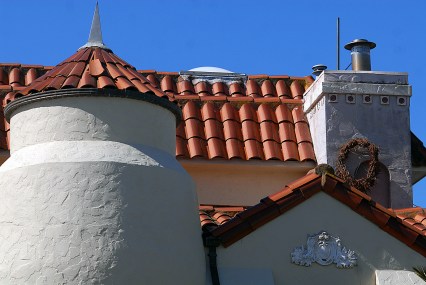
Photo by Thomas K. Pendergast
While Arthur focused on raising money and running the family business, Marian Realty, Oliver designed fanciful and opulent homes for middle-class buyers. Together, they built fewer than 200 homes and within three years their business had
gone bankrupt, but the homes they built influenced many San
Francisco architects who built after them. They were among the
first to make built-in garages standard and they popularized
central patios, for example.
Today, 93 of their “Rousseau” homes – concentrated within city
blocks on 33rd, 34th and 35th avenues, between Kirkham and
Lawton streets – are under consideration for historic landmark status.
“The proposed Rousseau’ Boulevard Tract Landmark
District Designation is intended to preserve the unique San
Francisco version of storybook-style architecture of this tract,”
said Gina Simi, communications manager for the SF Planning
Department. “The landmark designation ordinance is intended to
provide clarity to both property owners and future (Planning
Department) staff. Property owners will help tailor the landmark
designation ordinance to determine which types of alterations
would require additional review.
“Property owners were asked to rate the value they place on original and-or
compatible materials and design in order to help (the Planning Department) determine
which building features are most important to each property
owner. This information will be used to guide future discussions
and revisions to the landmark designation ordinance that will
ultimately help determine a consistent design review process for
the district,” Simi said.
During the 2012-2013 Sunset District Historic and Cultural
Resource Survey, the Rousseaus’ Boulevard Tract was identified as
a potential historic district and the Historic Preservation
Commission (HPC) adopted the Sunset survey findings on Sept.
18, 2013. The architecture of this district is described as “whimsical
and detailed,” representing a uniquely Bay Area version of
storybook-style architecture. Also along the blocks where the
Rousseaus are constructed are Tudor Revival, French,
Mediterranean, Spanish Colonial and Monterey Revival houses.
In a 2004 San Francisco Chronicle article, David Weinstein described the interiors
of some of the homes. “Inside the homes on 34th to 36th avenues, plans are nearly
identical. Main living areas are above the garage. You walk up a
flight of steps – beneath a medallion entry if the home is
French, an arch if it’s Spanish – and enter a foyer large enough
for the residents to use for their piano,” Weinstein said.
“You can turn right, into the living area, or proceed straight to
the bedrooms using a curved hallway. Separating living and
sleeping areas, and serving as the home’s fulcrum, is a center patio
open to the air and often freeform in shape. Many people use
it as a garden or children’s play area. Smaller Rousseaus on 33rd
lack the patio.
“The living room, which faces the street, is often sunk two steps
below the dining room. Arched doorways separate living and
dining areas. The doorways may have low, wrought-iron fences.
A breakfast room has a built-in hutch, the kitchen an alcove for
the stove,” Weinstein continued. “Downstairs is a two- or
three-car garage and a finished ‘social hall,’ with wet bar; many
have been converted into mother-in- law rooms.
Rousseau homes in the neighborhood have exposed
structural steel beams in the garages. Owners say they’re
found only in true Rousseaus, and are indicative of well-built
homes,” Weinstein said. According to Simi, there are
benefits to being in an historic district.
“If Rousseaus’ Boulevard Tract is designated by the Board
of Supervisors as a landmark district, property owners would be
eligible to apply for a Mills Act contract,” Simi said. “The Mills
Act Program provides a potential reduction in property taxes,
which is intended to help off-set the cost of maintaining and preserving
their historic property.
“There will be at least one more neighborhood meeting
(date T.B.D.) to discuss the draft landmark designation and ordinance.
Planning staff expects to present the proposed landmark
designation to the Historic Preservation Commission in May
or June,” Simi said.
Storybook-style houses feature towers, turrets, columns and
colonnades, along with mullioned casement windows,
arched or half-round doors, stucco siding and ornate hardware or
lighting fixtures. Along with bungalow and ranch-style houses, the storybook
style originated in California. It was the brainchild of returning
WW I veterans, who had discovered the charms of French and
English residential architecture.
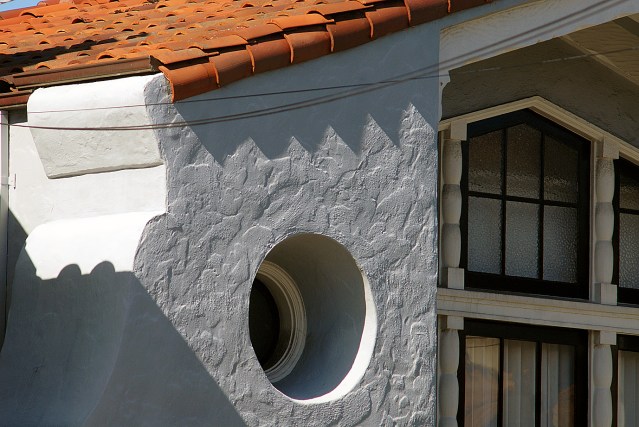
Photo by Thomas K. Pendergast
Categories: Architecture, Real Estate, Sunset Beacon, Sunset District


 Richmond Review/Sunset Beacon